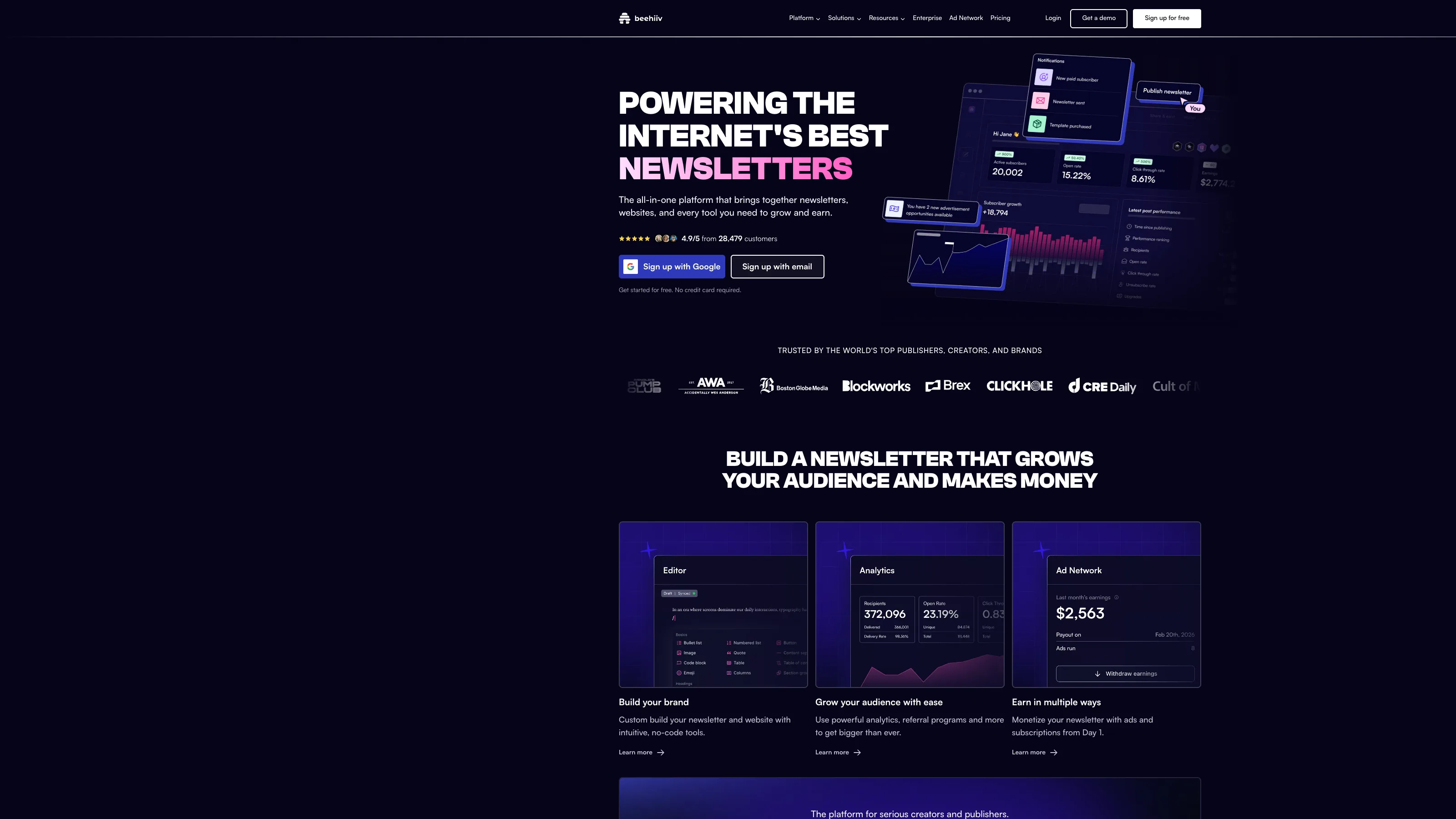
Beehiiv is what Substack would have been if Substack hadn’t tried to become Twitter. It’s a purpose-built newsletter tool made by people who watched Substack charge 10% of creators’ revenue and thought: we can do better. The result is the first email platform in a decade that looks like it was made for the sender, not the marketer. Growth tools, monetization, analytics — all of it sits inside a product that behaves like someone actually read the feature requests on its GitHub (metaphorically; Beehiiv isn’t open source).
Who it’s for
Best fit:
- Pure newsletter operators who write one thing — an email newsletter — and may or may not monetize it.
- Writers shifting from Substack who want to own their audience (Substack’s terms worry them) and want more growth tooling.
- AI coaches and content creators building audiences as their primary growth lever.
- Small SaaS founders running a content/newsletter strategy as their acquisition engine.
Not a fit:
- If your email strategy includes heavy automation (multi-step drip sequences, tagging, behavior-based flows) — ConvertKit is richer here.
- If you also need ecommerce integration (Shopify/WooCommerce) — Mailchimp or Klaviyo fit better.
- If you want a self-hosted or open-source option — Ghost is the answer.
Real pricing
| Plan | Price | What it includes |
|---|---|---|
| Launch (Free) | $0 | Up to 2,500 subscribers, all features |
| Scale | $49/mo (5k) → scales with subs | Multiple publications, custom domain, 3+ team seats |
| Max | $99/mo (10k) → scales | Removes Beehiiv branding, SSO, advanced reporting |
| Enterprise | Custom | Dedicated success, SLAs, custom billing |
The Free tier is not a stunt — it includes paid subscriptions, referral programs, and full analytics. Most newsletters won’t hit 2,500 subscribers for 6-12 months, so it’s a genuine runway.
What works
- Paid subscriptions, 0% Beehiiv fee. You pay Stripe’s standard processing (~3% + 30¢), nothing to Beehiiv. Substack takes 10%; ConvertKit Commerce is 3.5% + 30¢.
- Referral programs. Built in — you set up rewards for readers who bring in new readers, tracks referrals, handles the delivery. This is a category-leading feature.
- Boost (cross-promotion). Recommend other Beehiiv newsletters in exchange for them recommending you — a structured growth channel that meaningfully moves the needle.
- Analytics that mean something. Open rates, click rates, engagement scoring, top-performing posts, and revenue attribution for paid posts.
- Clean writing experience. Web editor is pleasant; distraction-free enough to actually write in.
What doesn’t
- Automation is basic. Welcome sequences yes; complex drip flows and conditional branching no. If you need real automation, ConvertKit wins.
- Integrations are limited. Compared to Mailchimp or ConvertKit, Beehiiv’s integration story is thinner. No deep Shopify/WooCommerce tie-ins.
- No landing pages (other than the newsletter subscription page). If you want separate marketing landing pages, you need another tool.
- API is maturing. Public API exists but coverage gaps vs Mailchimp/ConvertKit.
How we tested
- Account: paid Scale tier ($49/mo at 5k subs), running a paid + free newsletter with referral program active.
- Duration: 90 days (Feb 2026 – Apr 2026).
- Workflow: ~2,000 subscribers with ~100 paid subs, twice-weekly sends, active referral campaign, Boost recommendations turned on.
- What we measured: referral conversion rate vs expected baseline, revenue net of Stripe fees (Beehiiv charges 0% platform fee), analytics usefulness vs ConvertKit on the same list, migration effort from Substack (watched a 8,400-sub list migrate in a weekend).
The competition
- ConvertKit (Kit) — for creators who need more than a newsletter (sequences, landing pages, tagging). Full ConvertKit review.
- Substack — distribution-first bet. Loses on the 10% revenue cut and weaker growth tooling.
- Ghost — if you want a self-hostable publication platform with blog + members under one roof.
- Mailchimp — if you also need ecommerce integrations. Loses for pure newsletter creators.
- Buttondown — minimalist alternative for writers who want email and nothing else.
Verdict
Recommended for pure newsletter operators, especially those interested in monetization, referrals, or cross-promotion within Beehiiv’s network. If your email strategy is richer than “send newsletter” — if it includes automated sequences, tagged segmentation, landing pages, or ecommerce — ConvertKit covers more ground.

